
CIEMAT contributed POSEIDON expertise to the International Energy Storage Community
As part of POSEIDON’s ongoing commitment to advancing clean maritime technologies, project partner CIEMAT (Spain) contributed technical insights to the international debate on energy storage during the Frontiers of Energy Storage Workshop held in Rome (November 2025).
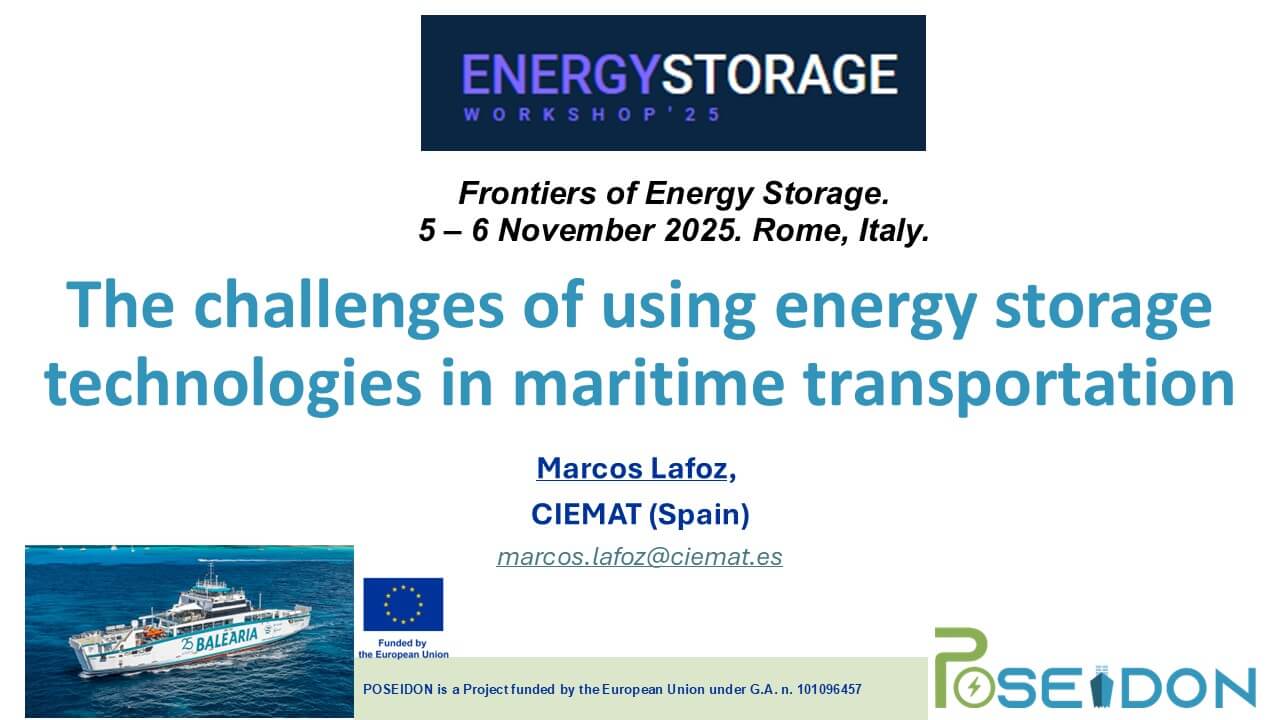
At the event, Marcos Lafoz (CIEMAT) presented the work carried out within POSEIDON under the title “The challenges of using energy storage technologies in maritime transportation”. The presentation focused on the technical, economic and regulatory dimensions of integrating advanced Energy Storage Systems (ESS) into maritime applications.
Rethinking energy storage for maritime electrification
Maritime transport accounts for approximately 3% of global CO₂ emissions. Achieving international decarbonisation targets requires not only alternative fuels, but also smarter and more resilient onboard energy management systems.
Battery-based systems have been widely used to reduce fuel consumption and emissions. However, as highlighted during the presentation, batteries presented significant challenges in marine environments, including faster degradation under harsh operating conditions and limitations in responding to rapid load fluctuations.
These limitations reinforce the need for complementary fast-response technologies capable of managing short-term, high-power demands efficiently and safely.
POSEIDON’s approach: Demonstrating alternative fast-response ESS
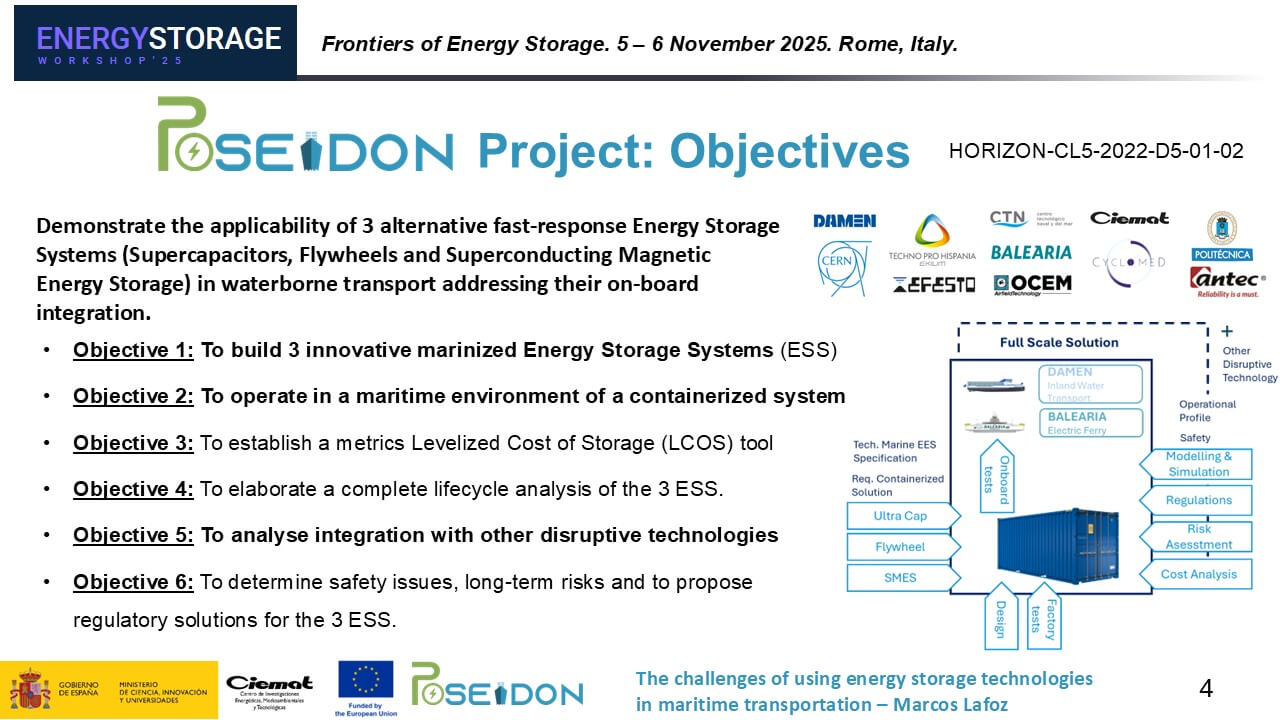
Under Horizon Europe (HORIZON-CL5-2022-D5-01-02, Grant Agreement No. 101096457), POSEIDON has been working to demonstrate the applicability of three alternative Fast-Response Energy Storage Systems (FRESS) in waterborne transport, addressing their onboard integration.
The technologies under development include:
- Supercapacitors
- Flywheels
- Superconducting Magnetic Energy Storage (SMES)
Structured objectives for maritime deployment
As presented by CIEMAT, POSEIDON’s work has been structured around clearly defined objectives :
- Building three innovative marinised Energy Storage Systems.
- Operating them within a containerised system in a maritime environment.
- Establishing a Levelised Cost of Storage (LCOS) metrics tool.
- Conducting a full lifecycle analysis of the three ESS.
- Analysing integration with other disruptive technologies.
- Identifying safety issues, long-term risks and proposing regulatory solutions.
This integrated framework ensures that performance validation, economic viability, lifecycle impact and certification aspects are addressed simultaneously.
Hybrid energy storage: A complementary strategy
One of the key insights shared was that short-term storage technologies are particularly suitable for specific onboard applications .
Rather than replacing batteries entirely, POSEIDON advances a hybrid energy storage configuration, combining conventional battery systems with fast-response technologies. This approach contributes to:
- Improved operational efficiency
- Reduced stress on batteries
- Enhanced system reliability under dynamic maritime conditions
Hybrid Energy Storage Systems were identified as a promising solution with clear advantages for maritime transport.
Lifecycle Cost and Certification as enablers
Beyond technological performance, POSEIDON applies a Life Cycle Cost (LCC) assessment methodology to evaluate total system costs over their operational lifetime . This long-term perspective supports informed decision-making and facilitates comparison between technologies beyond initial investment costs.
Certification was also highlighted as a critical enabler for onboard ESS deployment. Addressing safety requirements, long-term operational risks and regulatory compliance is essential to ensure effective real-world implementation.
Strengthening Europe’s maritime energy transition
Through CIEMAT’s contribution, POSEIDON shared evidence-based insights with the broader energy storage community, reinforcing the project’s role within Horizon Europe’s efforts to decarbonise maritime transport.
By advancing fast-response energy storage technologies, promoting hybrid system architectures and integrating lifecycle and regulatory considerations, POSEIDON contributes to making maritime electrification more feasible, reliable and economically sound.
The project continues to support the transition towards cleaner, more resilient maritime transport systems across Europe.